Written Contract Rules for Arizona Garage Door Jobs
A.R.S. 32-1158 sets the required contents for a written contract above $1,000 between a contractor and a property owner.[1] The Arizona Registrar of Contractors (ROC) points to that statute as the rule governing the minimum elements of a contractor contract.[4]
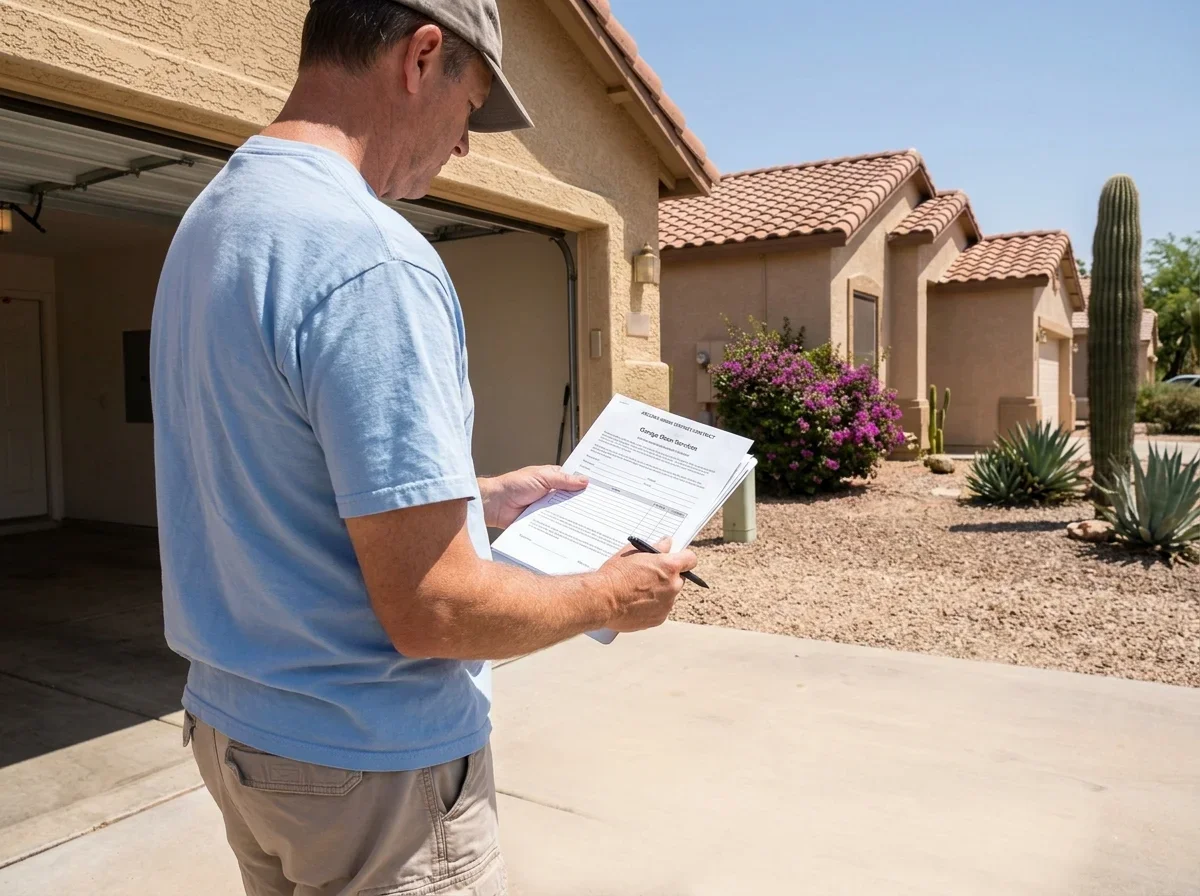
Licensing generally starts at the same $1,000 line, or earlier when a permit is required. The ROC license classes don't name garage doors as their own category. So the class printed on the license matters more than the word "garage" in a company's name.
Our guide to Arizona ROC licensing for garage door companies covers how to read it.
Plenty of repair quotes in Mesa, Tempe or Gilbert land near that $1,000 mark. A handshake deal on a spring and cable job leaves you with no record of what was promised.
If you haven't yet worked through questions to ask before hiring a Phoenix garage door company, do that before this stage.
Required Contents for Contracts Over $1,000 Under A.R.S. 32-1158
The statute lists what the written contract must include: the contractor's name, business address and license number, your name and the jobsite, contract and estimated completion dates, a description of the work, the total price including applicable taxes, any advance deposit, and the amounts and stages of progress payments.[1] The ROC's compiled statute book repeats the same list.[5]
The contractor must also hand you legible copies of what you sign, plus a signed receipt for any cash you pay.[1]
Use the table below against your quote.
| Required item | What it should say on your garage door quote | Source |
|---|---|---|
| License number | The ROC number, with the legal business name matching the one on the contract | A.R.S. 32-1158[1] |
| Dates | The contract date and an estimated completion date | A.R.S. 32-1158[1] |
| Description of work | The door model, springs, opener, hardware, removal of the old door and any testing or adjustment | A.R.S. 32-1158[1] |
| Total price incl. taxes | One total that includes tax, not a base price with tax added later | A.R.S. 32-1158[1] |
| Deposit | Whether a deposit is required and the amount stated in writing | A.R.S. 32-1158[1] |
| Payment schedule | Progress payments tied to named stages of the job | A.R.S. 32-1158[1] |
| ROC contact and complaint notice | The ROC phone number and website, with a complaint notice in bold type at least 10 points | A.R.S. 32-1158[1] |
The statute sets a floor, and a vague "garage door replacement" line can still technically satisfy it.
Push for more detail than the minimum. Scope should name the door, the springs, the opener and the haul-away, so you know what you bought and can compare quotes on identical specs.
Sample document
Detailed scope of work
Quote
- Door modelNamed on quote
- Springs and openerListed
- Haul-away of old doorIncluded
- Total price incl. taxesOne total
Illustrative example.
What Happens When a Contract Leaves Something Out
Section 32-1158(C) says these requirements are not prerequisites to forming or enforcing a contract. Noncompliance is not a defense to an action for payment or damages.[1]
A missing term doesn't void the deal. You may still owe the money, and you can't count on a gap in the paperwork to get you out of it.
That's why the time to insist is before you sign. Ask for the missing item to be added, and keep a full copy.
A missing license number deserves extra suspicion. Look the company up in the ROC contractor search at roc.az.gov and confirm the license is active and that its class covers the work.
Decide
Contract missing a license number
Does the ROC search show an active license whose class covers the work?
If Yes
then: Confirm it belongs to the business named on the contract
If No
then: Do not sign; the Recovery Fund route is closed for unlicensed companies
Make sure the license belongs to the business named on the contract, not a similarly named company.
If a salesperson solicits the job at your home, read any cancellation notice carefully and keep a copy. Use a traceable written method if you decide to back out.
The Residential Contractors' Recovery Fund
The Residential Contractors' Recovery Fund is run by the ROC and may pay eligible claimants up to $30,000 per residence when work to repair or complete the project is in progress or completed.[2][3]
$30,000
maximum Recovery Fund payout per residence
It is not insurance, and it doesn't cover every payment dispute. It is meant for owner-occupants harmed by the poor work of a licensed residential contractor.
The contractor must have been appropriately licensed when the contract was signed, the first payment was made or work began. Hire an unlicensed company and this route is closed.
Eligibility rules, claim steps and filing deadlines are set by the ROC. Confirm them at roc.az.gov/recovery-fund before you rely on the Fund. Don't assume a deadline you haven't verified.
The practical protection starts earlier: a licensed contractor, a detailed contract, and a signed scope that matches the work actually done.
Pro tip
Ask for the missing item to be added before you sign, and keep a full copy of the contract.
Related questions
- Arizona Legislature. "32-1158 - Contract requirements; provision of documents and receipts; inspection of records." https://www.azleg.gov/ars/32/01158.htm. Accessed October 17, 2026.
- Arizona Registrar of Contractors. "Frequently Asked Questions." https://roc.az.gov/faq. Accessed October 17, 2026.
- Arizona Registrar of Contractors. "Recovery Fund." https://roc.az.gov/recovery-fund. Accessed October 17, 2026.
- Arizona Registrar of Contractors. "Statutes, Rules and Policies." https://roc.az.gov/rules. Accessed October 17, 2026.
- Arizona Registrar of Contractors. "Arizona Registrar of Contractors Statute and Rules Book." https://roc.az.gov/sites/default/files/2024-09/2024%20Statute%20and%20Rules%20Book.pdf. Accessed October 17, 2026.